Contents · 7
Halloween opens the year-end season: the first occasion when shoppers actively look for deals and gifts, followed by Black Friday, Cyber Monday and the holidays. A store that runs Halloween well enters November with a warmed-up list, tested promo mechanics and clean analytics. A store that skips it ends up setting all of that up in a rush before Black Friday.
Below is what to prepare: discount mechanics, promo codes, BOGO offers, giveaways, email and messenger campaigns, and the technical side of the site. If the holiday is only two or three days away, jump to “What to do if Halloween is the day after tomorrow”.
Pick the mechanic by goal
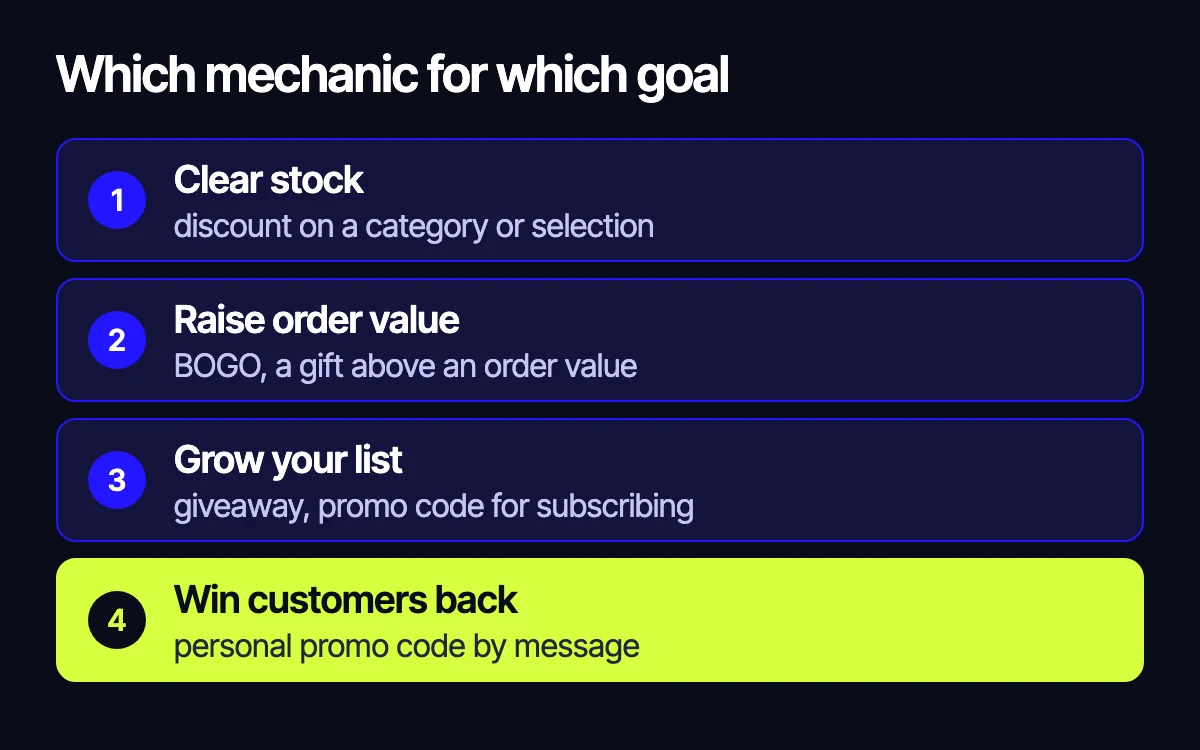
Clearing stock, raising average order value, growing your list and winning back past customers are four different jobs. Each has its own tool.
| Goal | Mechanic | Watch out for |
|---|---|---|
| Clear stock | Discount on a category or a “Halloween sale” collection | Keep the discount from eating margin on best-sellers |
| Raise average order value | Buy one get one, second item discounted, free gift over a threshold | Set the threshold slightly above your current AOV |
| Grow your list | Giveaway, discount code for signing up | Attract buyers, not prize hunters |
| Win back customers | Personal discount code by email | Segment: bought before, inactive for months |
A themed sale collection
The simplest option: a dedicated collection with a discount and a homepage banner. It works when the collection actually fits the holiday – decor, costumes, candy, gifts, themed packaging. A sitewide discount with no collection looks like any other sale and loses the occasion.
Discount codes
Codes are easy to track by channel, so create separate ones for email, SMS, social, influencers and ads. A themed word (BOO, SPOOKY, PUMPKIN) is easier to remember than random characters.
Before launch, check the rules: does the code stack with other discounts, does it apply to items already on sale, is there a minimum order, how many times can one customer use it. Most broken promotions break here: a code stacks with a sale price and the item sells at a loss.
BOGO and gift with purchase
“Buy one, get one free”, “second item 50% off” and “free gift on orders over X” lift order value better than a flat discount: the shopper gets a deal and you move more units. The mechanic has to apply automatically in the cart. If shoppers need to enter something or contact support, some of those orders will never happen.
Show progress on the product page and in the cart: “Add X more and the gift is yours.” That nudge works harder than any homepage banner.
A real deadline
Holiday promotions are short by nature: two or three days before plus the day itself. State the exact end date and stick to it. Shoppers notice countdown timers that reset on refresh, and trust drops.
Giveaways without the headaches

A giveaway brings reach and new subscribers, but only with clear rules. Publish them on a separate page before launch:
- entry period and the date winners are announced;
- how to enter: purchase over an amount, follow, tag a friend, comment;
- how the winner is picked: a recorded random draw or a live stream;
- the prize and how it is delivered, including who pays for shipping;
- who cannot enter, such as employees.
Check the rules of the platform you run it on and the sweepstakes and contest rules in the countries you target – in the US they differ by state. If entry requires a purchase, tie entries to order numbers: it makes verifying winners simple.
To grow a list of buyers rather than prize hunters, give away your own products, not generic gadgets.
Email, SMS and messenger campaigns
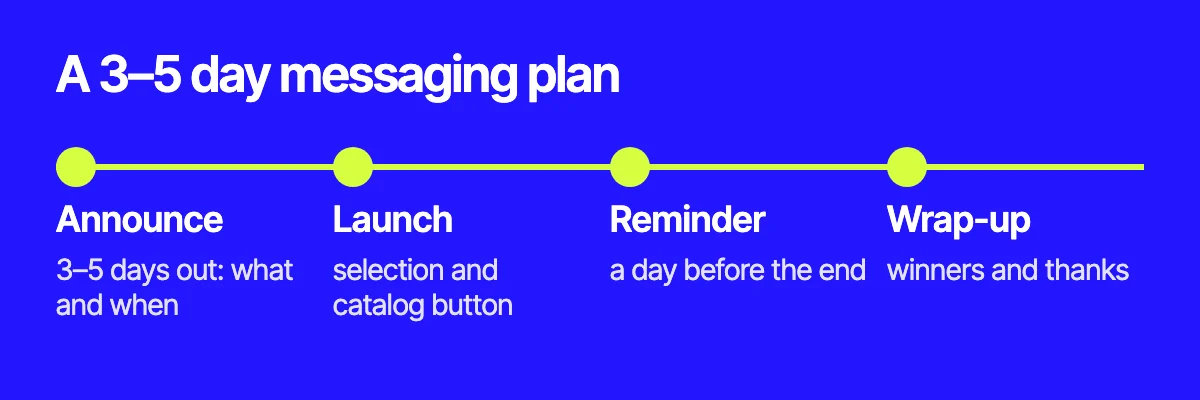
Your own list is the cheapest channel during holidays: ad costs go up, while sending to your subscribers costs the same as always. A working sequence over 3–5 days:
- Teaser 3–5 days out: what is coming and when, with early access or a separate code for subscribers.
- Launch: a short message with the collection and one button.
- Last call a day before the end: 24 hours left, low stock on popular items.
- Wrap-up: giveaway winners and a thank-you. A good moment to tease Black Friday.
In SMS, WhatsApp or Telegram keep it to one offer, one image and one link: long texts in messengers rarely get read. Add UTM tags to every link, or you will not know which channel drove the orders.
When you need a chatbot
Broadcasts are fine for announcements. A bot is worth it when the shopper has to do something: claim a personal code, enter a giveaway with an order number, check their entry, pick a gift. A bot in Telegram or WhatsApp issues unique codes, blocks duplicates, collects entries in a sheet or your CRM and sends reminders on its own.
We build these bots around the store’s promotion and connect them to the site and CRM, so codes and entries stay linked to real orders. See AI chatbot development.
Site checklist before launch
Holiday traffic arrives in a wave, and mobile, cart and payment take the hit first. The minimum checklist:
- Banner and collection. The homepage banner leads to the collection, not the catalog root. No out-of-stock items in the collection.
- Code field in the cart. Visible on mobile, with clear errors (“valid on orders over X”) and an instant recalculation.
- BOGO logic. Test combinations: two identical items, two different ones, a sale item plus a full-price one.
- Speed. Heavy holiday banners are compressed, animations don’t slow scrolling on phones.
- Payment and shipping. Place a test order with every payment method (cards, PayPal, Apple Pay) before launch, not after the first complaints.
- Analytics. Conversion events for orders and code redemptions, UTM tags on every campaign link.
For a deeper pass over product pages, cart and checkout, see our ecommerce CRO checklist. We check the same points in a conversion audit before seasonal sales.
What to do if Halloween is the day after tomorrow
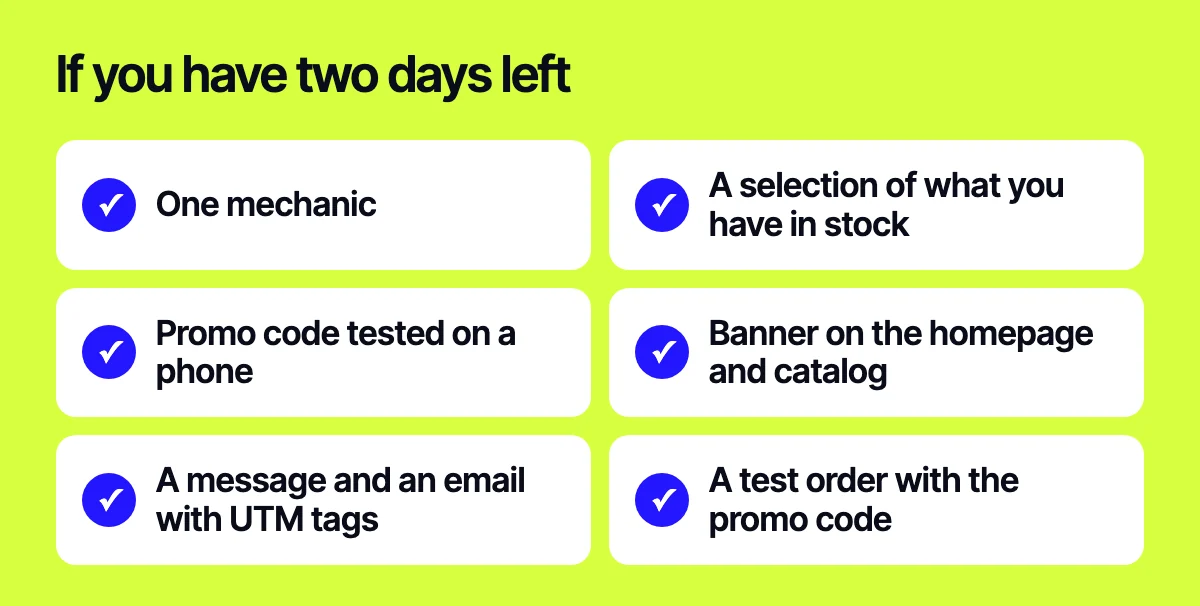
A full campaign won’t fit into two days, but a short promotion will:
- Choose one mechanic: a code on a collection or a gift over a threshold. Don’t launch everything at once.
- Build the collection from items you have plenty of in stock.
- Create the code and test it on mobile and on items already on sale.
- Put a banner on the homepage and at the top of the catalog.
- Send one email and one SMS or messenger message, with UTM tags.
- Place a test order using the code.
Whatever you don’t get to now, you’ll need in a month: Black Friday is Friday, November 27, 2026.
After the sale: a review before Black Friday
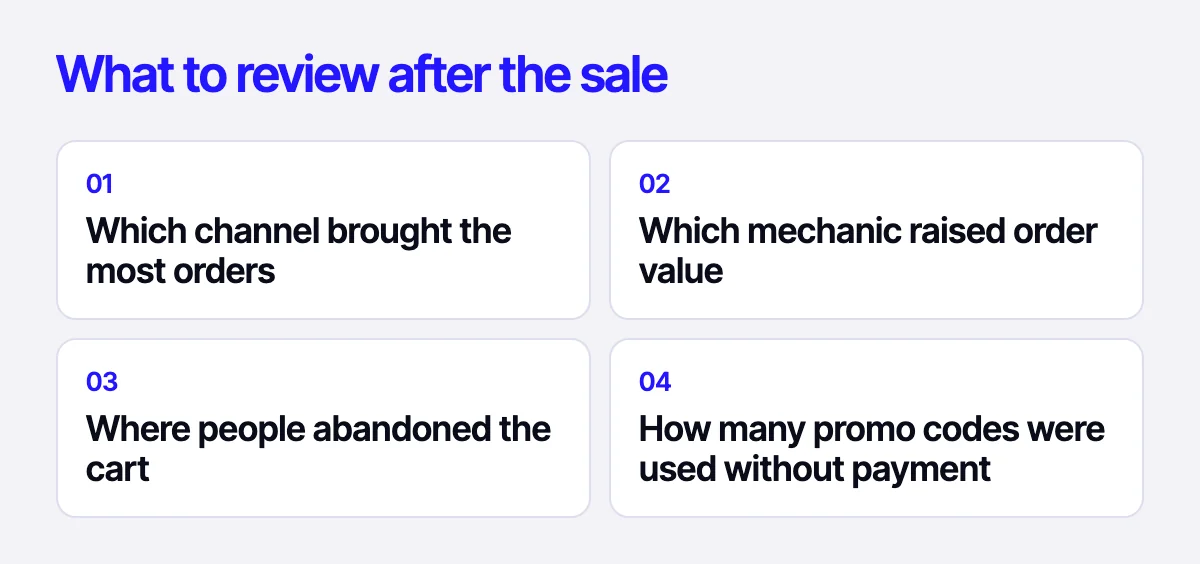
Halloween is a dress rehearsal. Right after it, look at which channel drove the most orders, which mechanic raised order value, where shoppers abandoned the cart and how many codes were applied but never paid for. Those answers are your Black Friday plan: what to scale, what to drop and what to fix on the site.
Related reading: where a Google Ads budget really goes; ways to increase average order value; what an AI assistant can really automate in a store.
Need help getting your store ready?
We set up codes and BOGO logic, test cart and checkout on mobile, build chatbots for codes and giveaways, and wire up analytics. Tell us what your online store runs on and what you want to launch. Reach us through the form on the site, on Telegram, WhatsApp or by email.
Leave your contact – we'll reply within one business day wherever suits you.