Contents · 12
- What Determines Your Conversion Rate?
- Go Through the Entire Purchase Process Yourself
- Digital Analytics Is the Key to Knowing Your Customer
- Mistakes That Lower Your Online Store’s Conversion Rate
- Mistake #1. Slow Website Loading
- Mistake #2. Not Enough Information on the Product Page
- Mistake #3. Complicated Site Navigation
- Mistake #4. Poor Logistics and Long Delivery Times
- Mistake #5. Weak Return Policy and No Guarantee
- Mistake #6. Mandatory Account Registration
- Mistake #7. Your Customers Aren’t Sure Their Personal Data Is Safe
- Mistake #8. Insecure Payment Solution

One of the biggest problems in ecommerce is unfinished purchases. According to statistics, 7 out of 10 shoppers (69.82%) leave an online store after abandoning their cart. Many factors can drive this decision, from slow page loads to an inconvenient checkout process.
The store owner’s job is to make the shopping experience as comfortable, secure and simple as possible.
In this article, we explain what conversion is, share tips on increasing your conversion rate and look at several common online store mistakes that significantly reduce it.
What Determines Your Conversion Rate?
The conversion rate is the ratio of buyers to the total number of visitors to your online store. Your main goal is to make a sale at the end of every visit. That goal is out of reach, of course: a normal ecommerce conversion rate is actually 1.5-2%.
For your business to succeed and generate consistent sales, you need to put in serious effort not only to expand your product range but also to improve your site’s content and usability. Make sure every customer need and potential objection is addressed, so that satisfied customers come back to buy again.
It is not an easy path, but it is one you have to take. Collecting data, tracking and analyzing your customers’ changing preferences – every metric matters when it comes to improving your store’s performance.
Go Through the Entire Purchase Process Yourself
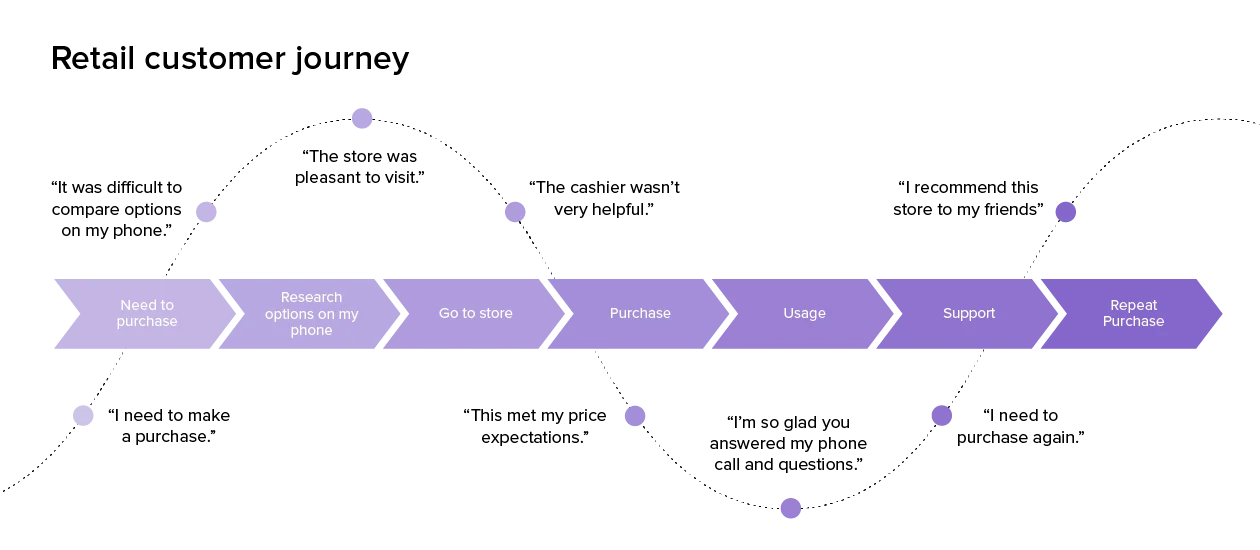
Understanding how your customer moves from the first visit and product browsing to the final checkout step will help you spot potential issues, optimize the site, increase the conversion rate and raise the average order value.
Knowing your target audience is one of the key components of your business. Define who your customer is: why they visit your store, what problem they want to solve, what matters to them when buying, where they live, how much they are willing to spend and so on. A thorough analysis answers these questions and helps you sharpen your product offer and build an effective sales funnel.
Digital Analytics Is the Key to Knowing Your Customer
Digital analytics means monitoring all of your business metrics and adjusting your strategy or individual processes as those metrics rise or fall.
When promoting an online store, you need to keep an eye on many processes and constantly answer questions such as:
- Which traffic sources are most effective?
- Which interests perform best on Facebook?
- Which locations are most profitable?
- Which creatives, copy and visuals bring in more clicks and sales?
- What is your site’s conversion rate? How and why does it change?
- Why do people abandon their carts?
- Which payment method do customers use most often? And much more.
Analyzing all visitor behavior metrics and identifying areas for improvement lets you keep increasing your conversion rate. In one of our articles, we covered how to track visitor behavior in your online store to uncover potential issues and further optimize the site.
Mistakes That Lower Your Online Store’s Conversion Rate
Once you have thoroughly analyzed customer behavior and interaction scenarios, the long, painstaking work of improving and optimizing your processes begins. To make it easier, we have put together several common mistakes that many online store owners make.
Mistake #1. Slow Website Loading
How do you feel about supermarket checkout lines? We bet they cause some stress and certainly don’t lift your mood or make you want to buy. Shoppers feel exactly the same when they visit your site and have to wait several seconds for a page to load.
Back in 2012, Amazon estimated that every extra second of load time could cost it $1.6 billion. (No wonder the Amazon platform is so fast today.)
Most visitors to your store will spend a few minutes exploring products in a category before deciding to buy. If navigation isn’t fast, convenient and intuitive, they will most likely leave without making a purchase.
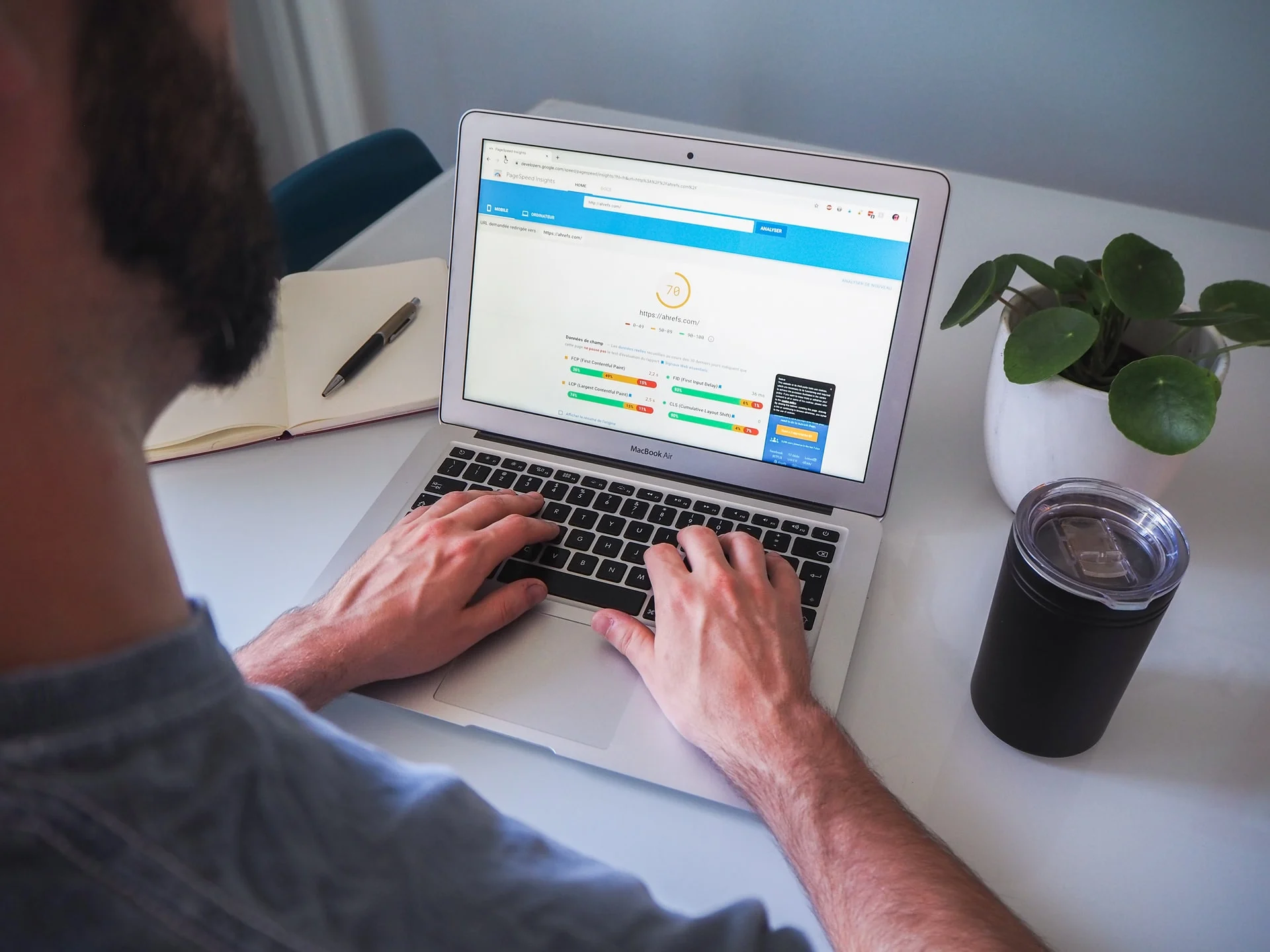
Google recommends an optimal load time of 1.5 to 3 seconds for an online store, yet 9 out of 10 sites take much longer to load. So if you achieve a good load speed, it becomes a competitive advantage, and your site will likely rank higher in search results.
Start by checking your site’s load speed. This will show you where to focus: on making the site faster or on other ways to optimize and improve it.
Mistake #2. Not Enough Information on the Product Page
Suppose you offer a high-quality product that is among the best on the market, and you trust your suppliers, yet despite all the obvious advantages your sales conversion is very low. In this case, people really do judge a book by its cover – or rather, a product by its page. If the product meets all the objective criteria of a winning product, the reason for low sales is most likely a poorly crafted product page.
A high price, a weak or missing product description, low-quality images, incorrect specifications, no delivery times, no trust badges or widgets, excessive upselling – all of these hurt the purchase decision.
Before you launch ads for a product, open its page and put yourself in a potential customer’s shoes. Pay attention to every small detail and ask yourself whether you would buy this product, and if not, why. Details that seem minor at first glance can seriously affect your site’s conversion.
Mistake #3. Complicated Site Navigation
Your customers are more likely to prefer simple pages that aren’t cluttered with unnecessary information. On such sites they can easily find answers to their questions and buy without wasting time. Here are a few simple tips to increase your conversion rate by optimizing navigation:
- Make the site mobile-friendly;
- Add links to all essential pages in the site header and footer;
- Keep the page structure and design consistent across your site;
- Use a clear call to action (CTA) that encourages visitors to add the product to the cart;
- Minimize 404 errors;
- Place the search bar somewhere prominent – let customers quickly find what they need;
- Make the cart and checkout pages as clear and simple as possible;
- Add a button to return to the previous page so customers can edit their cart. In the online stores built by our agency, we often use a side cart so users can review the items in their cart without leaving the page they are on.
If you work through all of the points above and fix any issues on your site, you will be well on your way to more orders and a higher conversion rate. Remember that you need to keep adapting to your customers’ changing behavior and preferences.
Mistake #4. Poor Logistics and Long Delivery Times
Another major issue shoppers face when buying online is logistics. Unlike brick-and-mortar retailers, ecommerce businesses must pay close attention to delivery times to earn customer loyalty, since 26% of customers abandon a purchase because delivery takes too long.
Shoppers care about the following:
- Delivery time;
- Shipping cost;
- Order tracking.
Long delivery times are a serious problem in B2C retail, but in B2B they can be offset by price or order volume. Remember, customers don’t like to wait.
There are 2 ways to handle shipping costs:
- Charge for shipping on single-item orders and offer free shipping on multi-item orders above a certain amount;
- Include shipping costs and taxes in the product price (works well for mid- and high-ticket products).
To shorten delivery times, we recommend shipping from your customer’s country or partnering with a dropshipping agent.
Mistake #5. Weak Return Policy and No Guarantee
Let’s face it: it is hard to judge a product’s quality objectively before you hold it in your hands. This is one of the biggest challenges for ecommerce entrepreneurs. When buying online, shoppers know in advance that the product may not suit them for various reasons. As a result, they expect guarantees that let them return the item if it isn’t to their taste or has obvious defects.
We recommend:
- Place a link to your return policy page in the footer. If you can offer better terms than your competitors, highlight this prominently (in the product description). Customers should know exactly what to do if a product doesn’t meet their expectations.
- In the worst case (if the product is low quality, has a manufacturing defect or doesn’t match the picture), customers need a guarantee that they can exchange it for a new one or get a full refund.
Mistake #6. Mandatory Account Registration
Did you know that roughly 3 in 10 visitors to your online store (34%) won’t complete a purchase if they have to create an account? We recommend setting up your store so that entering shipping and payment details is all it takes to buy. The faster a customer completes a purchase, the more likely they are to come back.
Amazon is a great example of a well-designed purchase flow. The platform will certainly remind you of the benefits of registering and having a personal account, but it never forces this on its customers.
Mistake #7. Your Customers Aren’t Sure Their Personal Data Is Safe
Every year, entrepreneurs and large companies invest in cybersecurity. Ecommerce businesses should pay special attention to protecting customer data.
When placing an order on your platform, customers inevitably share confidential information that must be reliably protected. Shoppers are increasingly aware of how important personal data protection is and rely on stores and platforms that guarantee security and provide a high level of protection.
It is essential that your site uses an SSL security protocol.
In addition, trust badges, which you should place on the product page, in the cart and at checkout, can also help increase shoppers’ confidence.
Mistake #8. Insecure Payment Solution
About 40% of people trust a site more if it offers a range of payment options. Customers should have easy access to different online payment methods.
PayPal and Stripe are among the most popular and secure ways to accept online card payments. They comply with international security standards and hold PCI Level 1 certification, the highest level of certification available in the payments industry.
In this article, we have covered the most common mistakes online store owners make. Follow our advice, and you won’t have to wait long for positive results!
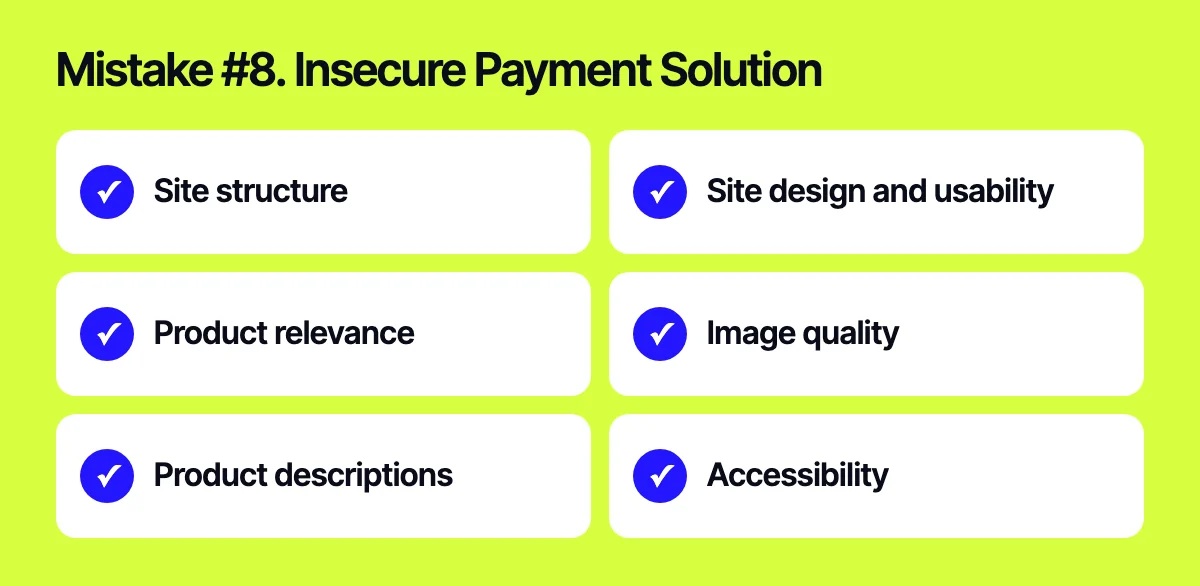
You can also contact us for expert help in increasing your online store’s conversion rate. Our specialists will fully analyze your site and prepare a detailed report covering:
- Site structure
- Site design and usability
- Product relevance
- Image quality
- Product descriptions
- Accessibility (how simple and accessible the site is)
- Information pages
- Site load speed
- Optimization for different devices
- Social media
- Errors
- Built-in online store settings
- A detailed action plan to fix weaknesses and substantially improve your site
What results can you expect?
- Higher ROI (return on investment)
- More sales
- A higher site conversion rate
- A more attractive site that sells better
The report runs 10-20 pages.
You can submit a request through our website.
Related reading: which platform to build a store on: OpenCart, WooCommerce, Shopify or Laravel; 12 places where an online store loses buyers; 17 ways to increase an online store’s conversion rate.
Leave your contact – we'll reply within one business day wherever suits you.